Black women and redundancies.
When we think of redundancies, most blame economic downturns or ‘organisational restructuring’, these terms help shift the blame from the employer.
In 2025, 319,000 Black women in the US lost their jobs between February and July, figures that made Rep. Ayanna Pressley (D-MA) write and urge Federal Reserve Chair Jerome Powell to help address the concerning statistics. In her letter, she says,
“In August 2025, 6.7% of Black women faced unemployment, which is above the already high national average of 4.3%. This disparity should not go overlooked as unemployment of Black women is a key metric of the health of the US economy.”
This statement alone is extremely powerful to me because the economic consequences of Black women losing their jobs are profound. But this is not unique to the US. According to the Runnymede report ‘The Colour of Money’, Black women in the UK have significantly lower wealth compared to white women and men, with Black African and Bangladeshi households holding approximately 10p for every £1 of White British wealth. For context, every £100,000 (c. $135,700) earned by a White British household, a UK Black African home earns on average £10,000 (c. $13,570)
In the US, according to the National Women’s Law Centre, Black women earn just 63 cents for every dollar earned by white, non-Hispanic men, a wage gap that magnifies the financial blow of job loss. When redundancies occur, Black women often have less of a financial cushion to absorb the shock, leading to greater instability and long-term setbacks.
As a Black woman, I first experienced redundancy in my late twenties, and later in my forties, both had a great impact on me. My first experience was when working at an advertising agency. I remember being one of three Black women in the agency, who were all made redundant, due to cost-cutting measures, or so we were told.
I was shocked that I couldn’t question why I was selected for redundancy. I felt like a failure, rejected, and it was compounded with sadness. In hindsight, I ask myself whether the agency needed a full-time bar, whether they needed a speed boat; all optics to impress clients.
It happened again, during COVID, even though I had much more experience. In this instance, I was on a PIP (Performance Improvement Plan), following a department restructuring. My senior role was no longer required, and I was then managed by a less-experienced manager who had recently been promoted. Her first act was to put me on the PIP, something which I believe can be weaponised by inexperienced leaders in organisations. Being on PIP means there’s no way back, the organisation doesn’t really want you to improve, the reality is, they want you out!
I’m not the only Black woman who experienced a PIP, which then led to a redundancy, during COVID. The Institute for Women’s Policy Research found that Black women faced unemployment rates nearly double the national average at the pandemic’s peak. Recovery has been uneven, with systemic barriers slowing re-employment and career rebuilding.
Black women have long been failed by biased systems and structures, including racist and sexist policies, that undermine their ability to thrive. The COVID-19 pandemic has been destructive for Black communities and coincided with a long-overdue consideration of racism in the US and the UK, particularly anti-Black racism, illuminating the experiences of Black communities. It also provided a new moment to listen closely to Black women and to reevaluate policies and social support for them. Alas, one can argue that anti-blackness is alive and kicking, years after the COVID pandemic.
Recently, IAWA International researched Gen-Z Black women who have been made redundant or are in the process. They all experienced a form of discrimination from inexperienced line managers who had never managed a redundancy process before; instead of offering support to these women, they resorted to bullying tactics.
These structural factors drive the disproportionate impact of redundancies on Black women. Workplace discrimination and unconscious bias often influence who is selected for redundancies, with Black women frequently overlooked for retention despite their contributions.
As I’m writing this piece, I conclude that the problem of ’Redundancy’ could be bad leadership and might have nothing to do with a person’s ability to carry out their work in instances where they have been performing.
Redundancies are not merely economic events; they are moments that expose and deepen existing inequalities.
For Black women, the impact is multifaceted, including economic hardship, psychological strain, and social disruption, all rooted in systemic barriers that need urgent attention.
McKinsey & Company created a ‘Women in the Workplace’ 2025 report, which has a cover that doesn’t include Black women.
Emphasising that addressing these challenges requires intentional, intersectional strategies that support Black women’s employment security and career growth. Only through such systemic change can we move toward a more equitable and resilient workforce.
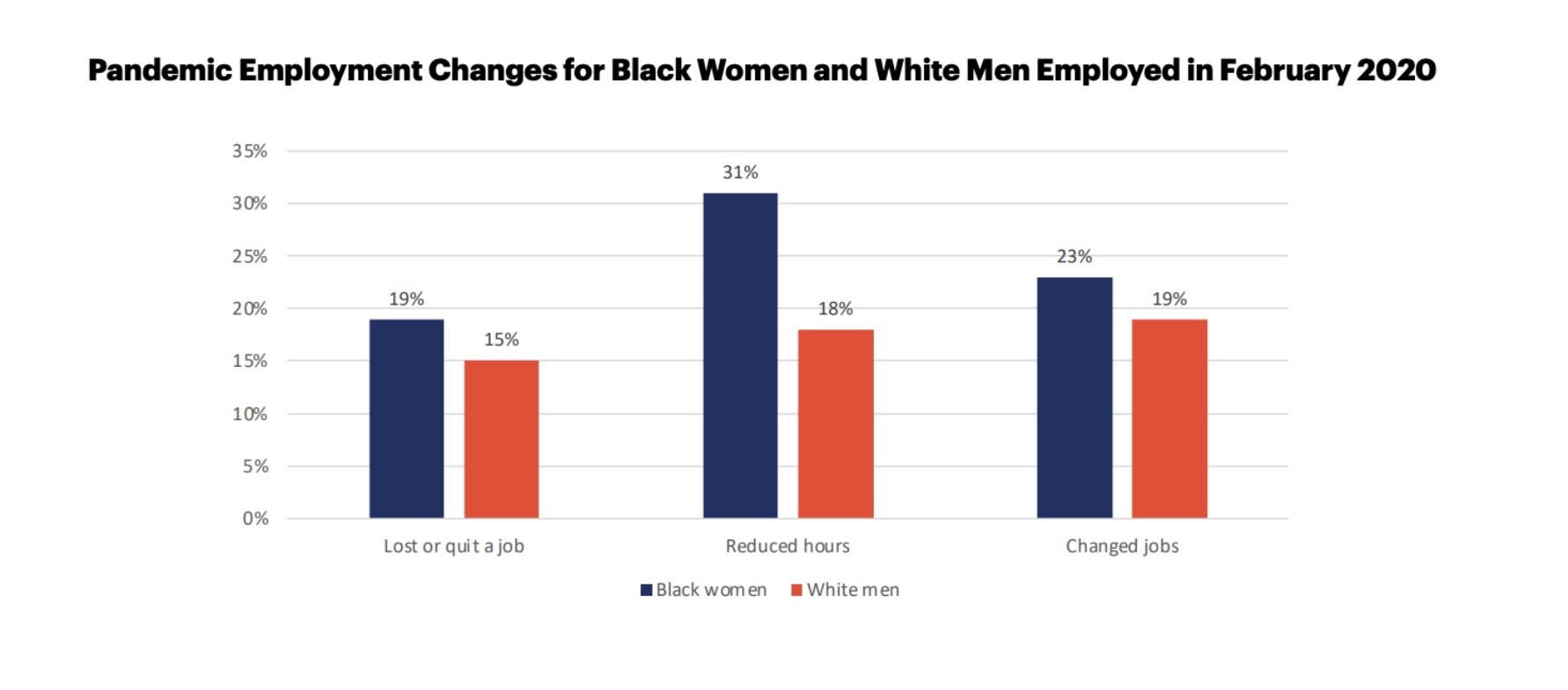
Pandemic Statistics February 2020
In recent years, I have worked in the non-profit/charity sector, where there are systemic problems, which have been highlighted in an article by ‘Charity So White’. In the article, they link White Supremacy and Redundancy.
They write;
“As restructuring and redundancy processes rip through the charity sector, we want to look at how charities are failing to live up to anti-racist values and defaulting to white supremacist notions of whose work is most valuable and most worthy of retaining.”
They write that leadership in this sector is predominantly White.
“Only 7% of charity CEOs are from a Global Majority background, whilst the number of Black CEOs has fallen to less than 1% in ACEVO’s 2023 Pay and Equalities Report. So it is clear that racial diversity within the sector does not translate to diversity within leadership.”
I wonder if this would be different if the leadership were more diverse. We don’t know now, maybe one day we will!
I refer to this because it seems there’s a problem across various sectors with how the Global Majority are treated in the workplace, when it comes to redundancy. The lack of leadership opportunities means that when redundancies occur, people from the Global Majority are likely to be the first to go.
Ayanna Pressley says in a YW Boston article:
“Black women have always been an economic indicator for what that means for everyone else. We have been the canaries in the coal mine. So, it is advantageous — and economists will support this — for us to better understand exactly what is happening to Black women and then do something about it,”
Finally, the rapid expansion of artificial intelligence (AI) has profoundly reshaped the global job market, triggering significant redundancies across multiple industries. At the time of writing, major corporations like Oracle have initiated large-scale redundancies, with thousands of employees worldwide losing their jobs as companies shift focus toward AI-driven innovation and automation. This intersection of AI-driven disruption and existing inequalities highlights the urgent need for inclusive workforce policies.
If redundancy happens to you, it’s important to understand what your rights are. My twenty-year-old self was consumed by shame and rejection. But I now know how redundancies impact Black women disproportionately to other groups, and if you’re experiencing it, ensure you get the right legal advice, speak out to those you trust for support and reach out to your community.
